Regular Periods and PCOS: What you may not have been told
How does PCOS affect your menstrual cycles?
PCOS can cause irregular, infrequent or absent periods because hormonal imbalances, including elevated androgen levels and insulin resistance, can disrupt ovulation. However, menstrual health is about more than whether you have a period. Cycle length, bleeding patterns and symptoms can all provide valuable insights. A women's health dietitian can help you understand these patterns and identify personalised nutrition and lifestyle strategies to support more regular cycles, including blood sugar balance, adequate nourishment, sleep and stress management.
If you have Polyendocrine Metabolic Ovarian Syndrome ( PMOS) - previously known as polycystic ovary syndrome (PCOS) - you may have been told that your periods are irregular but then left completely in the dark about what this means for your health and whether you can do anything about it. This can be really frustrating, and periods may end up feeling like an inconvenience to manage. In this blog post, we’ll help you understand your cycle patterns and what you can do to support them.
The common mistake people make: focusing only on whether your period comes
Do you measure a good menstrual cycle as whether bleeding occurs?
Well, a menstrual cycle is actually about far more than that. Here are some questions to ask yourself that may offer you further insights into your cycle:
How frequently are your cycles occurring?
What symptoms show up before or around menstruation?
Is this pattern changing over time?
Are there any long gaps (can be just longer than your usual) between cycles?
Although these details may seem small, they do matter to understand the full picture, and working together, I can help you understand more about your cycle and what you can actually do to support an irregular cycle.
What do irregular periods in PCOS tell you?
Irregular or absent periods may be caused by hormonal and lifestyle factors such as:
Insulin resistance, which can disrupt hormone balance and affect ovulation
High androgen levels (male sex hormones), which may also cause symptoms like hair loss/hirsutism, acne etc.
Chronic stress and poor sleep
Restrictive/poor diet, as your body may be missing out on key nutrients and will hold off on key processes like ovulation to try and maintain balance, which can lead to missed or irregular cycles
Weight - this is only one tiny piece of a much larger jigsaw.
Over-exercising or constantly making diet/lifestyle changes - this can be tempting given all the information floating around online, but can add further stress to the body.
All these factors together highlight an important message: PMOS is complex, and there is no one-size-fits-all solution. However, the menstrual cycle can act as a valuable source of feedback, offering clues about what kind of support your body may need.
If you have questions about PMOS/PCOS or your diet to support you in your PMOS journey, book a free enquiry call with me, a PMOS specialist dietitian, to find out how 1:1 support can help you.
When your cycle feels confusing or unpredictable
Living with PCOS can make your menstrual cycle feel like a mystery. Your periods may arrive months apart; you might spend weeks waiting without knowing when - or whether - one will come, or you may wonder whether you are ovulating at all.
These concerns are common, but that doesn’t mean you should be expected to accept irregular cycles without support or explanation. Being told that irregular periods are “just part of PCOS” can leave you feeling dismissed and unsure about what your cycle pattern means for your health.
The amount of conflicting advice online can make this even more confusing. You may see claims that cutting out carbohydrates, losing weight or taking a particular supplement is the answer. When everyone seems to have found a different “fix,” it can be difficult to know what is trustworthy or relevant to your body.
You deserve clear, personalised support that helps you understand what may be influencing your cycle - not another rigid set of rules.
It can also help to remember that progress is not measured only by whether you suddenly have a perfectly regular cycle. Although your menstrual pattern is important and any concerns should be discussed with a qualified healthcare professional, improvements may appear gradually.
You might notice that the gaps between your periods are becoming shorter, that your cycle is a little easier to predict, or that symptoms such as low energy, intense cravings or mood changes feel more manageable. These small shifts can provide valuable signs that your body is responding to the support you are giving it.
How working with CP Nutrition can help you with your cycles
As a women’s health dietitian, I won’t just ask, “Are you having periods?” and stop there. Together, we take a deeper look at your full cycle history and current pattern, symptoms, eating habits, lifestyle, and blood sugar picture to understand what may be influencing your hormones and what support might help.
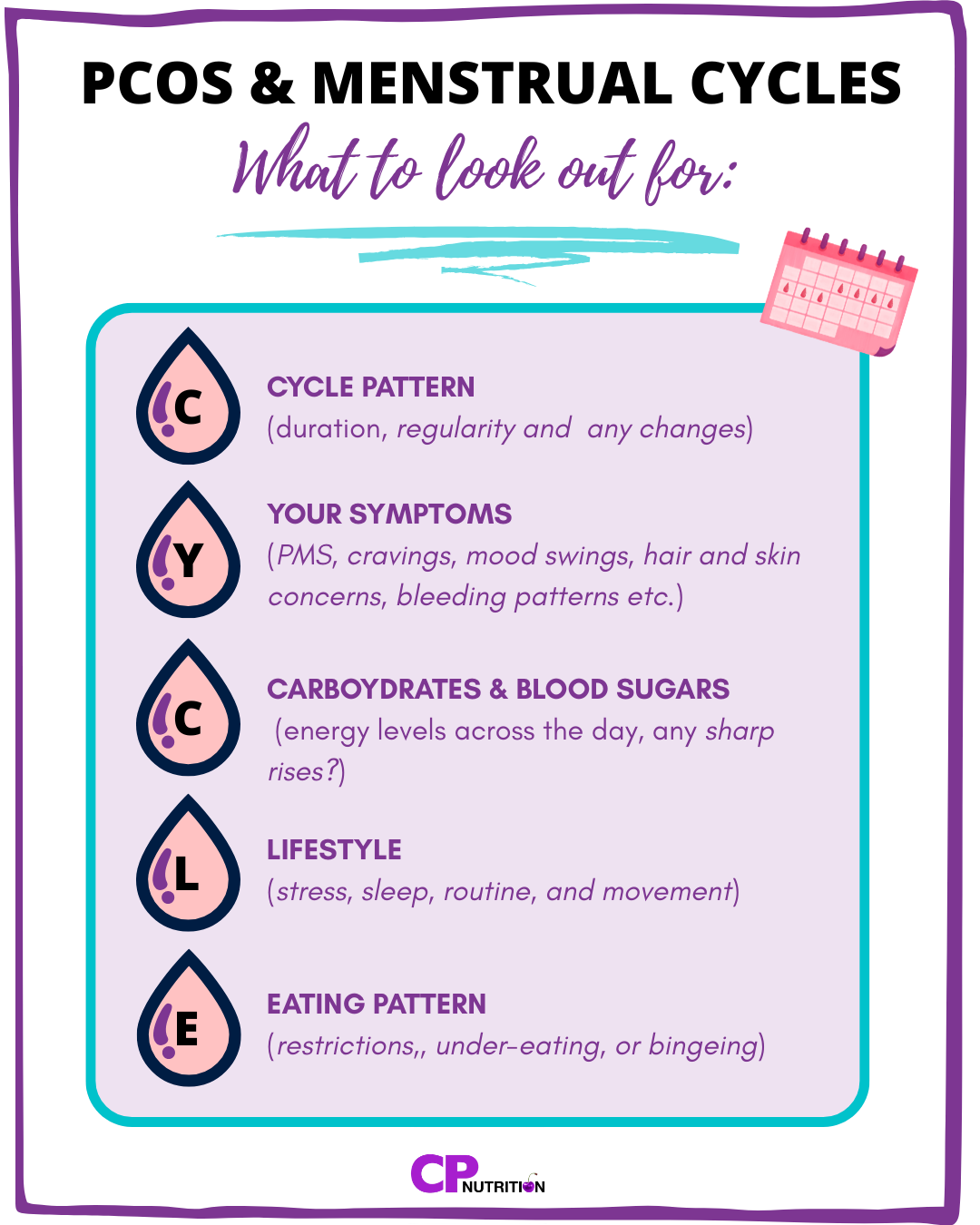
One helpful way to do this is with a CYCLE check
:
C: Cycle pattern
We’ll look at how long your cycles usually are, how regular they feel, whether anything has changed recently, and how predictable your bleeding is. For example, are your cycles getting longer, shorter, heavier, lighter or more spaced out?
Y: Your symptoms
Periods are only one part of the picture. We’ll also explore symptoms such as PMS, cravings, mood changes, acne, hair growth, fatigue, bloating, breast tenderness, spotting, heavy bleeding or painful periods. These can all offer clues about what your body may need more support with.
C: Carbohydrates and blood sugar
Blood sugar balance can play an important role in PMOS symptoms and cycle regularity. We may explore your energy across the day, whether you experience crashes, intense cravings, feeling shaky or needing something sweet to keep going. This helps us identify whether your meals and snacks are supporting steady energy and hormone health.
L: Lifestyle
Stress, sleep, movement, work patterns, routines and life demands can all affect your cycle. This is not about blaming you for being busy or stressed. It’s about understanding what your body is carrying and finding realistic ways to support it.
E: Eating patterns
We’ll also look gently at how you’re eating day to day. Are you skipping meals, restricting food groups, under-eating, dieting on and off, or finding yourself bingeing because your body feels out of balance? These patterns can affect appetite, energy, cravings and cycle health.
The aim of this deep dive is to look at the whole picture to help you identify practical, personalised strategies that support more predictable cycles, steadier energy, reduced cravings and better symptom management.
Elena’s story …..
Elena, 31years old, came to me after years of highly unpredictable menstrual cycles, often lasting anywhere from 35-60 days. Recently diagnosed with Polycystic Ovary Syndrome (PCOS), she felt completely disconnected from her body and deeply anxious about her long-term reproductive health.
When she first came to see me she was completely overwhelmed and exhausted by conflicting advice. Her search history was a chaotic mix of internet forums, wellness influencers, and well-meaning medical professionals. She had been told to go entirely keto, cut out dairy, eliminate gluten, try intermittent fasting, and do intense daily cardio.
In an attempt to follow this rigid advice, Elena had fallen into a draining cycle: skipping meals, trying to drastically cut carbs, and pushing herself hard at the gym despite operating on zero energy. Her frustration was sky-high as she felt like she was doing everything she could to improve her PMOS, but because her body was starved for fuel, she found herself feeling out of control with intense sugar cravings every evening, which she mistakenly attributed to a lack of "willpower."
Rather than giving her another strict protocol to follow, we shifted the focus entirely. Together, we mapped out a sustainable framework built on four critical pillars:
Blood Sugar Balance: Instead of fearing carbohydrates, we explored how to balance them - pairing slow-digesting carbohydrates (like quinoa or oats) with adequate protein and healthy fats to prevent the sharp insulin spikes and crashes that were driving her evening cravings.
Consistency over Restriction: Addressing her habit of meal skipping, we established a predictable routine of eating within an hour of waking up and refuelling every few hours to keep stress hormones (cortisol) low and keep her metabolism stable.
Symptom Patterns: Elena started a non-judgmental journal tracking not just the dates of her period, but her daily energy slumps, sleep quality, and mood swings. This helped her see the direct connection between a day of undereating and a night of intense cravings.
Realistic Nutrition Support: Together we designed a meal-prep structure that fit Elena’s busy corporate schedule. Nutrition support meant quick, real-food adjustments—like adding pumpkin seeds for zinc, utilising omega-3-rich fats to lower inflammation, and introducing a targeted inositol supplement to improve cellular insulin sensitivity.
The Outcome: Whole-Body Healing
Over the next six months, the overarching goal of our work evolved. It transformed from frantic "period chasing" into supporting the resilience of her entire body.
By stabilising her blood sugar and stopping the pattern of extreme deprivation, Elena's hormonal fatigue lifted. Her evening cravings completely vanished because her body finally felt safe and adequately nourished. As chronic metabolic stress decreased, her endocrine system responded naturally. Her cycles gradually shortened, stabilising at a predictable 30 to 32 days. Elena no longer viewed her body as a broken calculator to fix with restriction, but as an interconnected system that thrived on consistent, gentle support.
Mistakes we see at CP Nutrition
When you’re trying to improve your cycle, it’s completely understandable to want a quick fix - especially if your periods feel unpredictable, frustrating or like your body isn’t doing what it “should.”
But one of the most common things we see at CP Nutrition is people jumping straight into restriction before they’ve had the chance to understand what their body actually needs.
For example, many women cut carbohydrates first because they’ve heard this is the “best” way to manage PCOS. But cutting carbs too low can sometimes make things harder, leaving you with lower energy, stronger cravings, mood changes and more unstable blood sugar.
Another common trap is focusing only on weight loss. While weight is often talked about in PCOS spaces, it is only one part of a much bigger picture. Your sleep, stress levels, eating patterns, movement, blood sugar balance and overall nourishment can all influence your hormones and cycle health too.
It can also feel really disheartening when you make changes and don’t see results straight away. Cycle changes often take time, and progress may not look like trying to achieve a perfect 28-day cycle overnight.
That’s why, at CP Nutrition, we focus on the whole picture rather than chasing perfection. Instead of giving you another strict plan, we help you understand what may be influencing your cycle and find realistic, supportive strategies that work for your body, your symptoms and your life.
What can help instead?

So what do you actually need to support irregular cycles?
You need better explanations and tailored advice so that you don’t feel shame when your body doesn't follow a neat timeline.
Support with your diet is another way you can make a huge difference as it helps you to understand how blood sugar, PMOS symptoms, and hormones are all connected to what we eat.
And, most importantly, you need a holistic approach that factors in all symptoms, rather than just focusing on when menstruation occurs. This will have you feeling supported, less overwhelmed and far more empowered!
Final Thoughts
Your menstrual cycle is not random noise. Even though it may be confusing or frustrating if you have an irregular cycle, it shows you what’s going on in your body. Understanding your cycle is key not only to help you understand your PMOS journey but also to help you identify the best strategies to support your menstrual cycle. .
If you’d like gentle, realistic support in your inbox, join our free fortnightly email newsletter. You’ll get simple tips, recipes and support every two weeks - so you can feel less overwhelmed and more in control of your PMOS/fertility.
This article was researched and drafted by Maleeha Ali, a graduate dietitian. To ensure the highest standards of evidence-based practice, it was rigorously reviewed, edited, and approved for publication by Dr. Claire Pettitt, Founder of CP Nutrition.